
Milkweed for Monarchs
I’m no expert—but I’ve spent quite a bit of time researching how I can best help monarch butterflies. I started “Milkweed for Monarchs” as a passion project to do whatever I can to support them. Here’s some info about monarchs and why they’re so special, as well as some of my favorite resources if you’d like to learn more.
prefers full sun (6-8 hours)
Monarchs
-

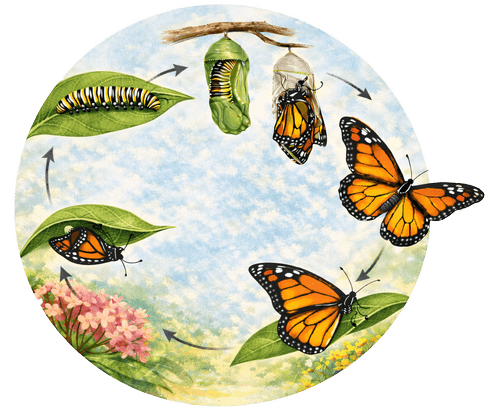
Lay eggs
The mama monarch lays her eggs on the underside of the milkweed leaf. Milkweed is the only plant monarchs lay their eggs on. No milkweed, no monarchs.
The egg typically hatches in 3-5 days.
-

Larva (Caterpillar)
When they emerge from the egg as a caterpillar, the first thing they do is eat the egg! They then eat milkweed leaves to grow. Over 9-15 days, it grows rapidly, shedding its skins five times (called instars). Milkweed contains cardiac glycosides (cardenolides) or neurotoxins that make the caterpillar toxic to any potential predators.
Take caution as milkweed is toxic to humans and pets as well. Wear gloves when handling milkweed, and be careful not to get any sap on your skin or in your eyes.
-

Pupa (Chrysalis)
Caterpillars can travel up to —feet away to find its home for the next 9-14 days. They hang in an upside down “J” shape and shed its skin once more to form a green chrysalis with gold spots.
-
Eclosing from chrysalis
Once the chrysalis is formed, it undergoes metamorphosis for 9-14 days (sometimes longer). The chrysalis turns clear about 12-24 hours before the butterfly emerges.
-
New List Item
Most monarchs will continue the path of migration (more on that later). There are 4-5 generations of monarchs that continue the path that their mom started; either flying
The eastern population flies east of the Rocky Mountains from Canada and the northern U.S. to overwinter in central Mexico.
The western population flies west of the Rocky Mountains to overwinter along the Pacific coast of California.
The “super generation” lives up to eight months by pausing their reproductive organs to survive through the colder months.